

CALL US TODAY FOR BEST PRICES, FAST QUOTES AND GREAT DISCOUNTS: 1300 404 226
CALL FOR BEST PRICES: 1300 404 226
Skip to content

Filters

Petrol Pressure Washers

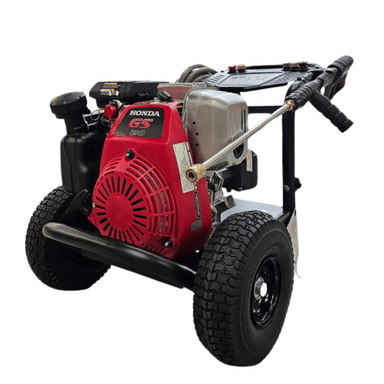
A petrol pressure washer goes where the power doesn't. No outlet, no lead, no three phase supply to arrange — start the engine and work, whether that's a remote site, a farm, a construction job or a mobile round where the nearest socket is a hundred metres away.

The range spans cold water and hot water models across a wide pressure and flow band, in trolley, skid, cube and trailer mounted configurations. Not sure which specification your work needs? Give us a call on 1300 404 226 and we'll match it before you order.

Which petrol pressure washer suits your work?

Petrol already answers the power question, so three decisions remain: whether you need heat, how much pressure and flow the job actually takes, and how the machine gets to site. Most operators start with PSI — which, on its own, is the specification that tells you least.

Cold water or hot water petrol

Cold water covers the majority of petrol pressure washing — mud, clay, compacted dirt, concrete, general site grime and vehicle washing all respond to pressure and flow alone. It's also cheaper to buy, simpler to service, and there's less to go wrong on a machine that lives in the back of a ute.

Heat earns its cost when the contamination is organic. Grease, oil, fats, proteins and biological matter break down chemically under hot water in a way cold pressure cannot match, no matter how much PSI you throw at them. Plant and machinery with baked-on grease, food handling areas, and livestock or processing environments are the cases where hot water isn't an upgrade but the specification.

Pressure and flow rate

Pressure breaks the bond between the dirt and the surface. Flow carries it away. Both matter, and the balance between them decides how the machine actually performs on your work.

  • Higher flow rinses a wider area per pass so large concrete pads, fleet washing and stockyards finish in fewer passes and less time.
  • Higher pressure cuts into bonded contamination so paint prep, heavy equipment buildup and hard deposits break loose without extra chemical.
  • A balanced mid-range specification handles mixed work so a single machine covers general site cleaning rather than being specialised for one task.

If your work is mostly large flat areas, favour flow. If it's stubborn deposits on smaller areas, favour pressure. If it's genuinely mixed, the mid-range is where a single machine earns its keep.

Engine and pump — what decides service life

The engine gets the attention, but the pump does the work and usually fails first. Look for a triplex plunger pump driven through a gearbox at reduced RPM rather than direct drive off the engine — lower pump speed means less heat, less wear and considerably longer service life under daily use. On the engine side, electric start saves the shoulder on a machine that gets started twenty times a day, and fuel injection improves starting and lets you track service hours properly.

Duty cycle is the specification that decides whether the machine lasts. A unit rated for occasional use will fail under daily commercial operation regardless of its headline PSI. Be honest about hours per day and days per week when you're comparing.

How the machine gets to site

Petrol machines are chosen for mobility, so the mounting format matters as much as the specification.

  • Trolley mounted units wheel around a site so one operator moves the machine without help or lifting gear.
  • Skid and cube mounted units bolt into a ute, truck or van tray so the vehicle carries the machine and the tow ball stays free.
  • Pressure washer trailers carry the machine and the water together on one chassis so mobile operators arrive ready to work with no mains connection.

Petrol, electric or diesel

Petrol is the middle ground and the most common choice for mobile commercial work. Electric pressure washers run quiet with no exhaust, which makes them the answer for indoor wash bays and fixed installations where fumes rule out an engine — but they need reliable power, and the higher-output machines need three phase. Diesel pressure washers deliver sustained torque with lower running costs at volume, which pays off on remote sites and long continuous shifts. Petrol sits between them: no power required, lower entry cost than diesel, and the widest range of specifications and mounting formats.

Frequently asked questions

Do I need hot water or will cold water do the job?

Cold water handles mud, dirt, concrete, general site grime and vehicle washing. Hot water is the specification when the contamination is grease, oil, fat, protein or biological matter — heat breaks those down chemically in a way pressure alone cannot. If you're unsure, describe the contamination rather than the surface and we'll tell you which way to go.

What PSI and flow rate do I need?

It depends on the surface and the contamination, not the machine. General commercial work sits around 2000–3000 PSI at 10–15 LPM. Heavy commercial and industrial work runs 3000–5000 PSI at 15–25 LPM or higher. Give us your application on 1300 404 226 and we'll recommend the combination before you order.

Why choose petrol over electric?

Power access. A petrol machine works anywhere — remote sites, farms, construction, mobile rounds — with no outlet and no electrician. Electric makes more sense for fixed wash bays and indoor work where fumes are a problem and the supply is already there.

Can I run a petrol pressure washer without a water supply on site?

Yes, with a tank. Trailer mounted units carry their own water, and skid or cube mounted machines can draw from a tank in the vehicle. Check the machine's flow rate against your tank capacity to work out realistic run time between refills.

How long will a petrol pressure washer last?

It comes down to duty cycle and pump specification more than brand. A gearbox-driven triplex plunger pump running at reduced RPM will outlast a direct drive pump several times over under daily use. Match the machine's rating to your actual hours rather than the headline pressure figure.

Related categories

Further reading

Aussie Wide Shipping

Fast and competitive

Lifetime Support

Product lifetime support

Spare Parts

We source spare parts

Buying in Bulk?

Request a quote